


Dezawa MuseCells in Austin, Texas
NeuroSolution Center of Austin offers Dezawa MuseCell therapy for severe, chronic neurological conditions under the Texas Medical Freedom Act. Led by board-certified neurosurgeon Dr. Marcella Madera and functional neurologist Dr. Brandon Crawford, our Catalyst Regenerative Integration program provides access to this investigational therapy backed by over 100 peer-reviewed publications.*

Last Updated:
June 4, 2026
Medical Director
Dr. Marcella Madera, MD
Functional Neurologist
Dr. Brandon Crawford, DC, FIBFN-CND
What Are Dezawa MuseCells?
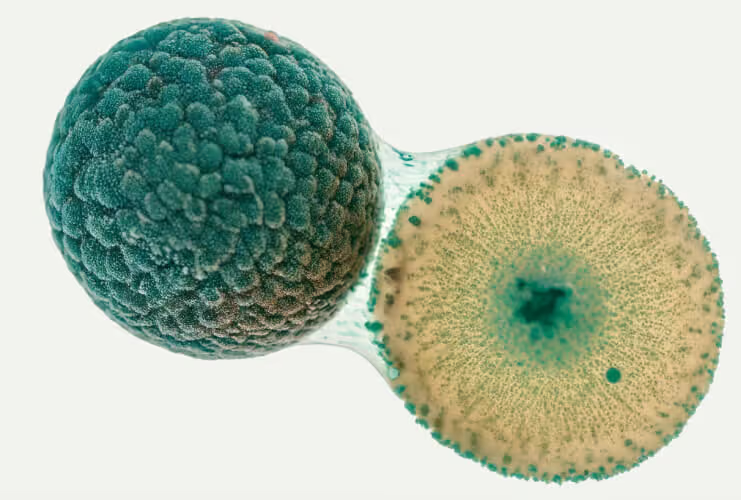
Dezawa MuseCells (Multilineage‑Differentiating Stress‑Enduring cells) are a unique population of adult‑derived stem cells originally discovered by Professor Mari Dezawa, MD, PhD. In published research, they appear as a rare subset within mesenchymal stem cell populations that can naturally differentiate into many different tissue types without genetic reprogramming.
How the Studies Describe MuseCells
MuseCell Characteristics
- Pluripotent‑like: Capable of differentiating into cell types from all three germ layers (ectoderm, mesoderm, and endoderm) in vivo.
- Non‑tumorigenic: In more than a decade of preclinical and clinical work using licensed production methods, no teratoma formation has been reported.
- Stress‑enduring: Able to survive in low‑oxygen, inflamed, or nutrient‑poor environments where many other cells fail.
- Immune‑tolerant: Expressing markers such as HLA‑G and IDO that have allowed allogeneic use without HLA matching or immunosuppressants in trials.
Because of these properties, Dezawa MuseCells have become one of the most extensively studied pluripotent‑like adult stem cell platforms, with more than 100 publications and multiple Phase I/II clinical trials conducted outside the United States.
Conditions Treated with Dezawa MuseCells
We consider Dezawa MuseCell therapy for patients with severe, chronic conditions who have not achieved adequate improvement with standard treatments, including:
- ALS (Amyotrophic Lateral Sclerosis)
- Anoxic Brain Injury
- Autism Spectrum Disorder
- Balance & Coordination Disorders
- Chronic Inflammation
- Chronic Pain
- Complex Regional Pain Syndrome (CRPS)
- Developmental Delays
- Dysautonomia
- Movement Disorders & Dystonia
- Neuropathy & Nerve Pain
- OCD (Obsessive-Compulsive Disorder)
- Paralysis
- Seizure Disorders
- Spinal Cord Injury
- Stroke (subacute ischemic)
- Tourette Syndrome
- Traumatic Brain Injury (TBI)
All patients undergo comprehensive evaluation to determine appropriateness for Dezawa MuseCell therapy. Not all patients are candidates.
How Dezawa MuseCells Work
In clinical and preclinical research, intravenously administered Dezawa MuseCells appear to:
- Home to Sites of Injury: Following chemotactic signals and sphingosine‑1‑phosphate gradients to damaged tissues, including brain, spinal cord, heart, liver, and skin.
- Calm Chronic Inflammation: Modulating immune activity and microglial activation, and reducing excessive inflammatory cytokines.
- Support Repair and Tissue Renewal: Differentiating into local cell types, promoting angiogenesis, and providing trophic support that helps stabilize or regenerate injured tissue environments.
Some early case reports have also explored changes in DNA methylation‑based biological age across multiple organ systems following MuseCell infusions, showing intriguing but preliminary shifts in measured “system age.” These findings are hypothesis-generating only and do not guarantee individual outcomes.
All of these mechanisms are still being actively researched, and not all findings have been reproduced across large, controlled trials.*
Where They Have Been Studied
Internationally, MuseCell‑based products have been studied (not approved) in a range of conditions.
Studied Conditions
- Subacute Ischemic Stroke: Randomized, placebo‑controlled trials of intravenous MuseCells have reported favorable safety and signals of improved motor recovery compared to placebo, with benefits persisting over follow‑up in some studies.
- Spinal Cord Injury: Human and animal studies have suggested safety, improved functional scores, and evidence of cell integration into injured spinal tissue.
- Amyotrophic Lateral Sclerosis (ALS): Phase II studies have shown MuseCell products to be generally well tolerated, with exploratory data on slowing functional decline in some patients.
- Other Organ and Skin Conditions: research has explored potential benefits in myocardial infarction, liver disease, lung injury, skin disorders, and systemic inflammatory states.
These uses remain investigational, and results have been mixed and context‑dependent. No MuseCell therapy is currently approved by the U.S. Food and Drug Administration for any indication and results from international studies may not predict individual outcomes in our patients.*
Our MuseCell Protocol Philosophy
Through Catalyst Regenerative Integration at NeuroSolution Center of Austin, our use of Dezawa MuseCells is intentionally conservative and grounded in neurology, functional medicine, and regulatory awareness.
Key Principles of Our Approach
- Severe, Chronic Disease Focus: We consider MuseCells only for patients with severe, chronic neurologic or systemic conditions where standard and advanced therapies have not led to adequate improvement, and where Texas Medical Freedom Act criteria appear to be met.
- Comprehensive Evaluation First: Every potential candidate undergoes a detailed assessment with our medical team, including neurological evaluation, review of prior treatments, imaging and laboratory data where appropriate, and discussion of standard‑of‑care and alternative options.
- Informed Consent and Documentation: If MuseCell therapy is considered, patients receive thorough counseling about the international research, potential risks, unknowns, and alternatives, and participate in a robust informed consent process. This includes clear acknowledgment that the therapy is investigational and not FDA‑approved.
- Careful Rollout and Monitoring: We are beginning with a limited number of patients, close follow‑up appointments, and structured tracking of safety signals and functional outcomes. Our goal is to learn responsibly while protecting patient safety and honoring patient autonomy.
We do not promise cures, disease reversal, or guaranteed functional outcomes from Dezawa MuseCell therapy. Every case is evaluated individually, and many patients will not be appropriate candidates.**
Risks, Unknowns, and Alternatives
Like all investigational cell therapies, Dezawa MuseCells carry potential risks and uncertainties.
Known Safety Data
International clinical trials have generally reported favorable safety profiles for MuseCell products, including intravenous administration without HLA matching or immunosuppressants, and no reported teratoma formation in studies using licensed manufacturing methods.
Uncertainties and Limitations
Long‑term safety in broader patient populations is still being investigated, and there may be risks that have not yet been identified. Outcomes can vary widely, and many patients may experience no meaningful improvement. MuseCell therapy should not be viewed as a replacement for evidence‑based standard of care.
Alternatives
For every patient, we review standard neurologic care, rehabilitation strategies, pharmacologic and non‑pharmacologic options, and other regenerative or functional medicine approaches that may be appropriate. MuseCells are considered, when appropriate, as one potential investigational option within a broader care plan—not a singular solution.
Important Disclaimers
* Dezawa MuseCell therapies offered at NeuroSolution ATX are not approved by the U.S. Food and Drug Administration (FDA) for the treatment of any disease or condition.
** These therapies are investigational and are made available under the Texas Medical Freedom Act (SB 773) for certain patients with severe, chronic disease, at the discretion of a licensed physician and with informed consent.
*** Information on this page is for educational purposes only and is not a substitute for personalized medical advice, diagnosis, or treatment. Always consult your physician or qualified health provider regarding any medical condition or treatment decisions.
Frequently Asked Questions About Dezawa MuseCells
View commonly asked questions about Dezawa MuseCells. If you have any additional questions then reach out to our team directly!
Where can I get Dezawa MuseCell therapy in Texas?
Who provides Dezawa MuseCell therapy at NeuroSolution?
What conditions do you treat with Dezawa MuseCells?
Is Dezawa MuseCell therapy FDA approved?
How is NeuroSolution's approach to Dezawa MuseCells different?
What is the evidence behind Dezawa MuseCells?
How much does Dezawa MuseCell therapy cost at NeuroSolution?
What is the first step to explore Dezawa MuseCell therapy?
Are Dezawa MuseCells Right for You?
If you are living with a severe, chronic neurologic or systemic condition and are interested in whether investigational Dezawa MuseCell therapy might be discussed as part of your care, the first step is a comprehensive consultation with our medical team.
During this consultation we will
- Review your medical history, prior treatments, imaging, and laboratory results.
- Discuss the current international evidence around MuseCells, including what is known and what remains unknown.
- Explore risks, potential benefits, and alternative options tailored to your situation.
- Determine whether MuseCell therapy could be appropriate to discuss further under Texas Medical Freedom Act criteria.
Request a consultation with our team to evaluate your situation and discuss your treatment options at NeuroSolution Center of Austin, Texas.

Find Out If You Qualify
This is a conversation, not a commitment. Our team will review your inquiry and follow up within one business day to understand your situation and determine whether a full evaluation makes sense.

